

TL;DR:
Malaysia's Carbon Tax 2026 will increase operating costs for export manufacturers relying on grid power — but on-site solar generation offers a direct, bankable hedge. This article explains how industrial solar panels reduce Scope 2 emissions, lower taxable carbon exposure, and support long-term compliance, so you can make a well-informed capital decision before the policy takes effect.
Malaysia's Carbon Tax 2026 is a structural shift in operating costs — not a distant policy debate. For commercial and industrial property owners, particularly those in export manufacturing, the combined pressure of domestic carbon pricing and international border adjustment mechanisms is set to erode margins in ways that energy efficiency tweaks alone cannot address.
Deploying an industrial solar panel system is one of the most direct, financially quantifiable responses available: it reduces your dependence on carbon-intensive grid electricity, lowers your reportable emissions, and positions your facility ahead of tightening regulatory requirements.
Why Carbon Tax 2026 Hits Export Manufacturers Hard
Malaysia's Carbon Tax 2026, aligned with the National Energy Transition Roadmap and supported by the Ministry of Energy Transition and Water Transformation (PETRA), is designed to price carbon emissions directly into industrial operations. For manufacturers exporting to the EU and other regulated markets, the financial exposure extends well beyond domestic compliance.
How Carbon Tax Impact on Exporters Changes Your Energy Bills
Export-oriented manufacturers face a compounding pressure: carbon costs applied domestically, and carbon border adjustments at the point of export. The EU's Carbon Border Adjustment Mechanism (CBAM) — already in transitional operation — requires importers to account for the embedded carbon intensity of goods including steel, aluminium, cement, fertiliser, and electricity-intensive products. Malaysian manufacturers supplying these sectors are directly in scope.
Malaysia's grid still carries significant carbon intensity given its gas and coal generation mix, as reported by Tenaga Nasional Berhad (TNB), meaning grid-dependent facilities carry elevated Scope 2 emissions and higher declared carbon content. For a mid-sized C&I operation consuming 500,000–2 million kWh annually, even a modest carbon levy adds materially to production costs — and these are scheduled, mandated increases that margin-sensitive exporters must plan for now.
Future-Proofing Export Manufacturing Against Rising Carbon Costs
The trajectory of carbon pricing globally is unambiguous: it moves upward. The International Renewable Energy Agency (IRENA) projects that as energy transition accelerates, carbon pricing mechanisms will broaden in scope and increase in rate across ASEAN and globally. Malaysian manufacturers with energy-intensive processes who delay structural energy decisions today will face significantly higher transition costs in the years ahead.
Future-proofing in this context does not mean speculative investment. It means aligning capital expenditure with regulatory and market direction — deploying infrastructure that reduces your taxable carbon footprint at a known, bankable cost, before carbon pricing makes inaction more expensive than action.
If your facility consumes significant grid electricity and you export into carbon-sensitive markets, now is the right time to quantify your carbon tax exposure and model the offset potential of on-site generation. Request a commercial solar assessment to understand your numbers before the 2026 policy takes effect.
How Industrial Solar Acts as Your Carbon Cost Hedge
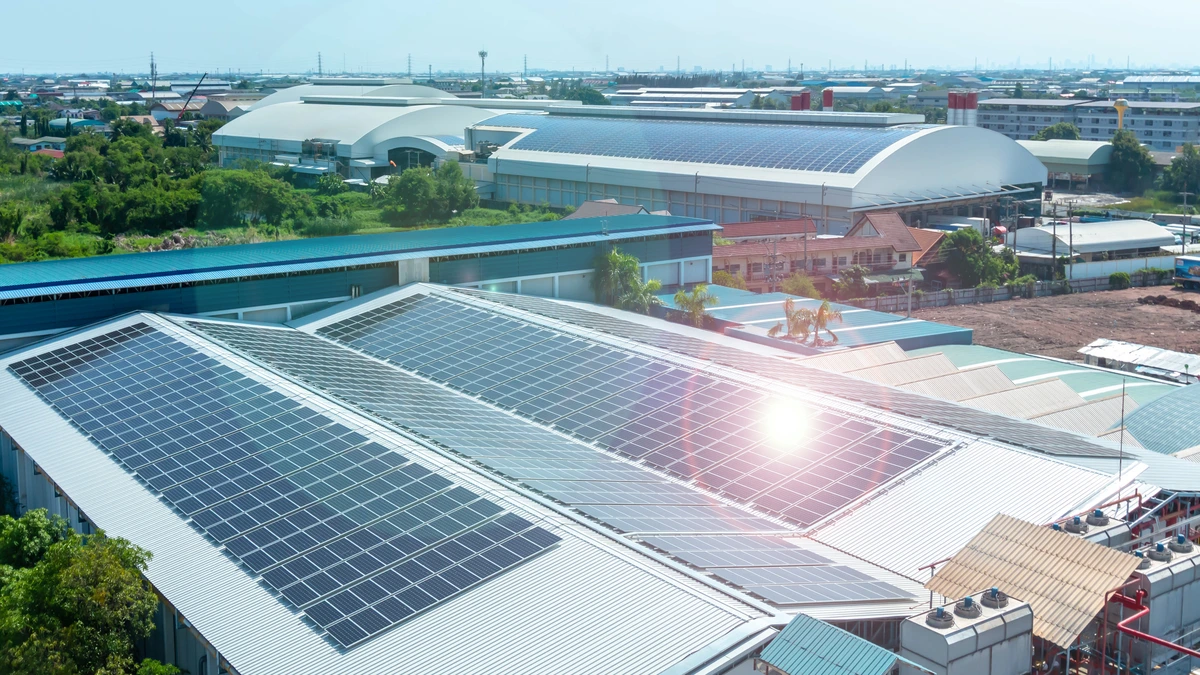
Installing an industrial solar panel system is not simply an energy decision — it is a carbon liability management strategy. When your facility generates electricity on-site from a zero-emission source, you directly displace the carbon-intensive grid electricity that would otherwise attract tax liability. The financial logic is structural, not incidental.
According to IRENA's renewable energy cost data, utility-scale and commercial solar PV continues to be among the lowest-cost sources of new electricity generation globally. In Malaysia's tropical context — where solar irradiance averages between 4.5 and 5.5 peak sun hours daily — the generation economics are consistently favourable for commercial and industrial projects across most roof and land configurations.
Reducing Scope 2 Emissions with On-Site Solar Cuts Tax Bills
Scope 2 emissions — those arising from purchased electricity — are directly addressable through on-site generation. Every kilowatt-hour produced by your rooftop solar system is a kilowatt-hour you no longer purchase from the grid, reducing your reportable emissions and, under Malaysia's carbon pricing framework, the volume against which liability is calculated. The Sustainable Energy Development Authority (SEDA) administers the Net Energy Metering (NEM 3.0) programme, allowing excess generation to offset future consumption and further strengthen your financial return.
For manufacturers under ESG reporting obligations — increasingly a prerequisite for supply chain participation in European and Japanese markets — documented Scope 2 reduction provides measurable, auditable progress toward net-zero commitments under frameworks such as CDP, GHG Protocol, and CBAM declarations.
Smart Malaysia Carbon Tax 2026 Compliance Through Solar
Compliance under Malaysia's Carbon Tax 2026 framework, governed in part by the Energy Commission (Suruhanjaya Tenaga) and SEDA, requires accurate energy and emissions accounting. Solar generation, when properly metered and documented, provides a verifiable offset within this framework.
Early movers gain a compounding advantage. Manufacturers who install industrial solar panels before 2026 will have established lower emissions baselines, secured capacity at current capital costs, and accumulated performance data to substantiate carbon reporting — while those who delay face higher demand, compressed timelines, and less room to demonstrate compliance readiness.
Getting Your Industrial Solar System Installed Right
The financial and compliance case for industrial solar is well-established. The critical variable is execution. An undersized, poorly sited, or non-compliant system will underperform against its financial model and may not satisfy the metering and documentation standards required for carbon tax offset recognition. Getting installation right from the outset is not optional — it is the difference between a strategic asset and a costly underperformer.
Professional Assessment for Maximum Carbon Tax Savings
A rigorous solar assessment for a C&I property covers load profile analysis, structural evaluation, shading and orientation modelling, TNB grid connection requirements, and financial modelling that incorporates carbon tax offset value alongside standard payback and IRR calculations. Each element determines how much of your carbon liability the system can credibly offset, and how quickly capital is recovered.
An EPCC (Engineering, Procurement, Construction and Commissioning) provider with documented C&I experience approaches this as a technical scoping exercise — not a sales process — ensuring the system configuration is right before any commitment is made. Installation must also comply with the SEDA's Guidelines for Solar Photovoltaic Installation, Malaysia's authoritative reference for grid-connected solar PV standards; engaging a provider who meets and documents these requirements protects both your asset and your regulatory standing.
Contact Northern Solar for Expert Industrial Solar Panels Solutions
Northern Solar is an EPCC solar provider specialising in commercial and industrial solar panels PV system design, installation, and commissioning across Malaysia. As an EPCC company — not a panel manufacturer — our team assesses your site, designs a system optimised to your consumption profile and carbon compliance requirements, procures quality panels from established vendors, and delivers a commissioned, grid-connected system that performs to specification.
For manufacturers evaluating solar as a carbon liability hedge, we provide structured assessments that translate your energy data into a financial model — including projected carbon pricing savings, NEM 3.0 offset returns, and payback analysis. To ensure your solar investment is sized, compliant, and performing as intended, contact us for a site assessment today.